From 56% to 87%: AI use surges among German trade fair organisers
An AUMA study shows that 87% of German organisers already use AI in 2026. What the data reveals, what it doesn't, and what you should review in your own work.

Nearly nine out of ten German trade fair organisers already use AI in their work. The data comes from an AUMA study this year [1] and compares to the 56% recorded in 2024 [2]. If reading it made you think “then I should probably be doing something I’m not,” this article is for you.
What the AUMA study actually shows
AUMA is the German association for the trade fair sector. Their AUMA-Veranstalter-Ausblick 2026/2027 report surveyed 93 trade fair organisers and asked whether they used AI applications in their work area. 87% said yes [1]. The equivalent report from the previous year shows that in 2024 that percentage was 56% [2].
You can see the 2026 report’s entry in Athena, Sinapser’s free industry research database. The 2025 report, which contains the 2024 figure, is available on the AUMA 2025/2026 report page in Athena.
That’s a 31-point jump in two years. And while there are limitations to what this number can tell you, the direction is hard to ignore.
What this comparison can’t tell you
The 2025 report doesn’t publish the survey base, so we don’t know if both rounds reached the same group of organisers. The comparison shows a trend, not a longitudinal follow-up of the same professionals over time.
The study also doesn’t specify which applications they use or how frequently. That 87% covers very different scenarios: someone who occasionally generates text with ChatGPT versus someone running a conversational assistant answering questions during booth setup. The data doesn’t distinguish between them.
That’s why you shouldn’t use it to conclude that the sector has truly integrated AI yet. What the study measures is whether respondents use any AI application in their work. That’s a good adoption indicator. It’s not an indicator of how deeply they’re using it.
Why the directional shift still deserves attention
With all those limitations in mind, there’s something this data does say clearly: majority adoption is no longer a prediction. It’s the baseline.
In 2024 just over half of the trade fair organisers surveyed used it; in 2026, 87%. The study does not say why, or for which tasks. That second question is one you can answer yourself, by looking at your own work.
There’s one more thing worth noting: as adoption spreads, many event professionals feel less equipped to leverage it well, not more. That’s not a contradiction. Expectations are rising and tools are evolving faster than workflows. The fact that 87% say they use AI doesn’t mean 87% knows what to ask it.
Moving from using AI to having it integrated into your events
The difference between “I use AI” and “I have AI integrated into my events” doesn’t show up in overall productivity. It shows up in very specific work moments.
Repetitive questions. On an incentive trip with multiple shuttle times, messages start before breakfast: What time does the bus leave, which gate, is there plenty of time. If you have an assistant ready that answers the repeated questions with the information you have given it, those questions never reach anyone on your team’s phone. If you don’t have it, they land with whoever should be somewhere else at that moment.
Last-minute changes. The client writes at nine Wednesday evening: Room C moves to Room A for the closing session. Your team has three people with different script versions. Without anything set up, you send an email and hope they read it before eight. With a shared place where the team checks event changes, everyone sees the same version. The following Monday you don’t have to reconstruct what happened.
The debrief that never gets written. You know how this ends: Monday there’s too much work piling up, the debrief gets pushed to next week and never happens. Six months later when you run the same event for the same client, half of what you learned last time lives only in whoever was there. If that person has moved to a different project, that knowledge walks out the door.
None of these three scenarios requires understanding technology. They require knowing what you want to solve before someone helps you build it.
What’s worth reviewing before your next event
If the German data made you think you should be doing something different, the most useful starting point isn’t to search for a tool: it’s to write down the questions that repeat most often in your events and the tasks you replicate identically each time.
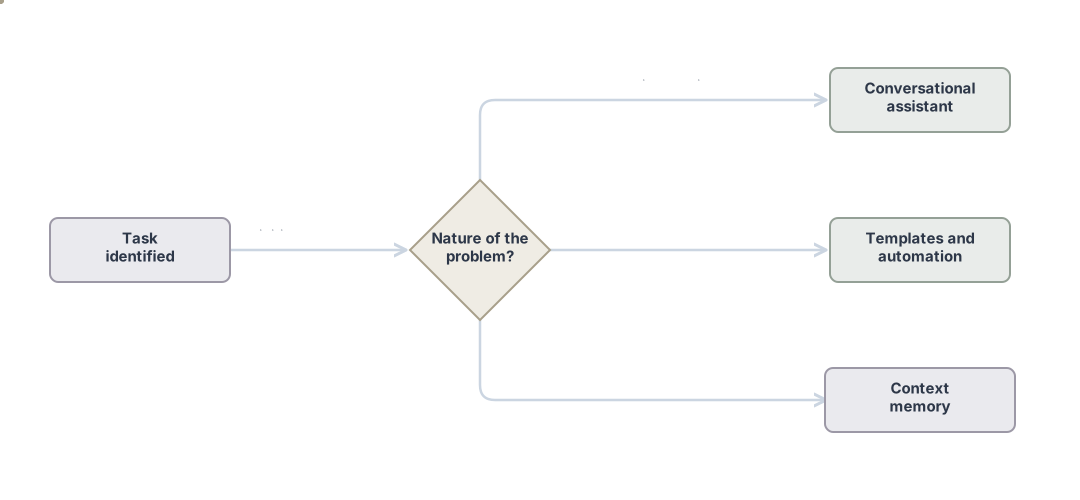
Repetitive questions are the first candidate for a conversational assistant. Tasks you do the same way every time (welcome script, confirmation messages, speaker calls) are the first candidate for an AI template or automation. And event context (briefings, decisions, scope changes) is what has the most value to preserve in a way that your team can reference without depending on someone remembering it.
How to prioritise where to start is explained in this article. What no industry study can tell you is how much it will change for your specific event type. You know that better than any percentage.
If you want to discuss a specific event and see where AI fits into your operations, Sinapser can help you identify it.
Sources
- AUMA-Veranstalter-Ausblick 2026/2027: Veränderte Erwartungen treiben die Entwicklung der Branche (AUMA, 2026): 87% of German trade fair organisers use AI applications in their work area (p. 16, n=93). Entry in Athena.
- AUMA-Veranstalter-Ausblick 2025/2026: Messen zwischen Effizienzdruck und Innovationsschub (AUMA, 2025): 56% of German trade fair organisers used AI in 2024 (p. 12, base not declared). Entry in Athena.
Frequently asked questions
Does this only apply to German trade fairs or is it relevant to my work?
The study covers only the German trade fair market. That doesn’t mean you should replicate what they do, but the conversation about what to automate and what not to is already a present-day discussion, not a future one.
If almost everyone already uses AI, am I falling behind?
Not necessarily. That 87% ranges from someone who used ChatGPT once to draft a call for speakers to someone with automated workflows running across several events per year. If you’re already using AI to prepare texts, summarize meetings, or update a briefing, you’re part of that group. The more useful question is whether there’s any task in your work where AI could free up real time before your next event.
What do I need to move from using AI occasionally to having it integrated into my events?
Basically two things: knowing what you want to solve (the logistics question that comes in forty times, the script no one has updated on event day, the debrief that never gets written) and having someone help you connect the tools to your event-specific information. The technical side isn’t your job. Identifying the problem is.
How do I know if what I’m doing with AI counts as integration or just occasional use?
Here’s a simple way to think about it: Does the tool work during the event without you having to be there? Using ChatGPT to prepare an email before the event is use. Having an assistant answering attendees’ questions while you’re out on the floor solving something else approaches integration much more closely. The difference isn’t technical. It’s operational.
Related articles

AI use in events is growing. Why do professionals feel less capable?
MPI reports more regular AI use and lower self-rated ability. What does the study actually measure, and what does it mean for your events team?

Where to start with AI at your events
Where AI has real impact at an event, where it still makes no sense, and how to choose the first process without buying a trend.

Your team uses AI: how to share the context of your events
Work with EVA Brain from a shared project memory so proposals and production briefs use the knowledge of the whole team.